
Research-ready data
Access normalized market, fundamental and reference data through Data Gateway APIs and Python workflows, with point-in-time context, consistent instrument identities and visible sources.
Quant research
Data Gateway, robust backtesting and reproducible analysis around your models - from research-ready inputs to a strategy you can challenge and a portfolio you can evaluate.
For quantitative researchers, systematic investment teams and research engineers.
The operating reality
A promising backtest is the beginning of the discussion. Was that fundamental value available at the time? Did the universe include delisted instruments? Which costs were assumed? Can a colleague recover the inputs and reproduce the result after a provider revises its history?
When those answers depend on one notebook or one researcher’s memory, review becomes reconstruction. Research infrastructure should keep the data, assumptions, configuration and results close enough that the team can challenge an idea and decide what to investigate next.
Can another researcher rerun this result, challenge its assumptions and assess its portfolio impact?
Built for your team
Access normalized market, fundamental and reference data through Data Gateway APIs and Python workflows, with point-in-time context, consistent instrument identities and visible sources.
Test strategies in Backtester with explicit costs, slippage, borrow and financing. Challenge results with walk-forward analysis, parameter stability and stress periods.
Keep inputs, assumptions, configuration and outputs with every run so another researcher can recover the result and challenge its assumptions.
Evaluate accepted signals against portfolio weights, exposures, liquidity and risk before turning a research result into a proposed allocation.
A workflow in practice
An illustrative workflow: a researcher tests a strategy, challenges the result and evaluates a candidate allocation. Each stage has an explicit input and an output the next person can inspect.
Select sources, instruments and observation dates. Check the available history and point-in-time coverage.
Data GatewayMake strategy parameters and execution assumptions explicit, and retain the run configuration.
BacktesterReview costs, walk-forward behaviour and sensitivity before accepting the evidence.
BacktesterAssess a candidate allocation against weights, exposures and risk before proposing a portfolio change.
OneBook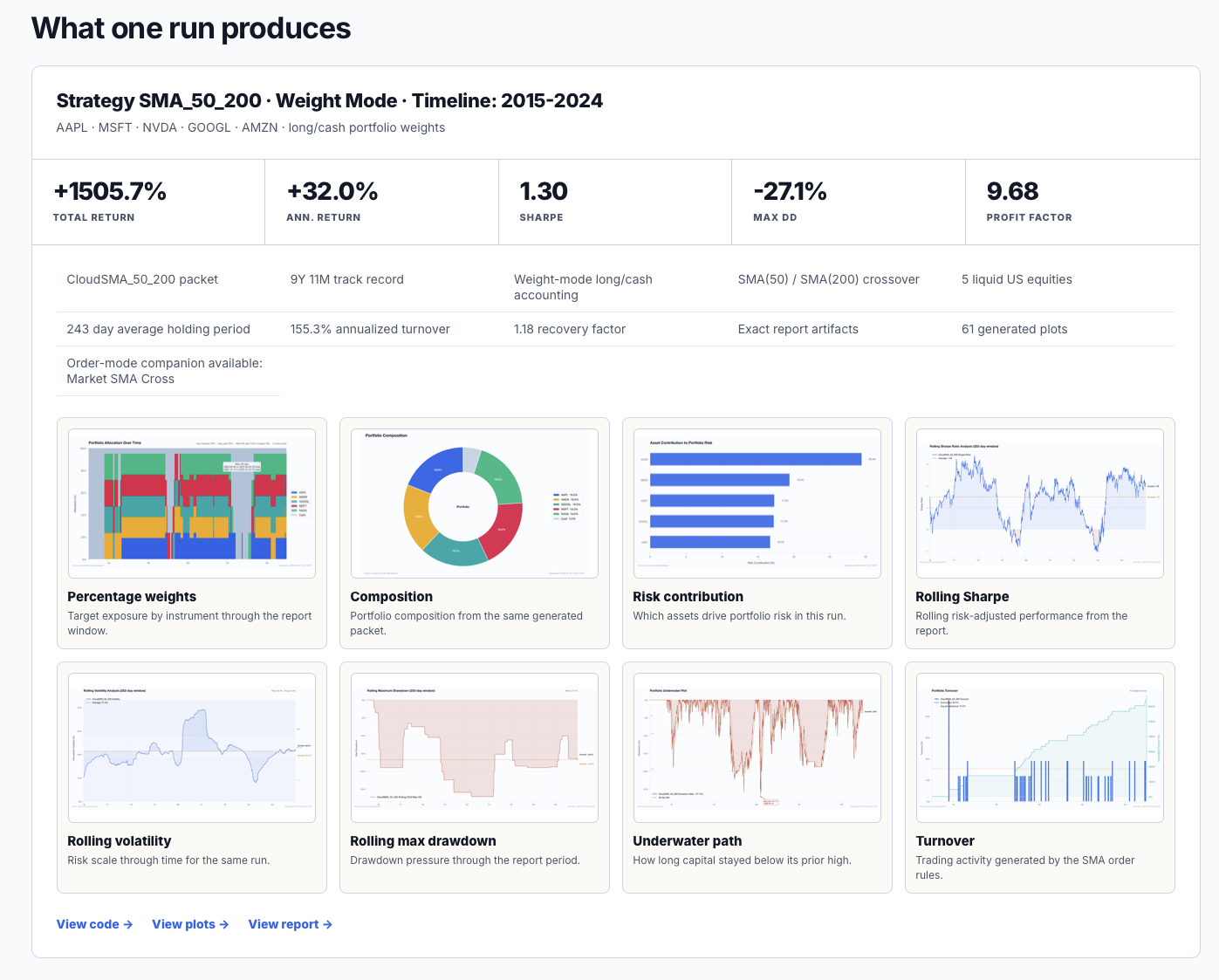
Inspect strategy metrics and charts, then challenge the assumptions and execution settings behind the result.
How it fits your stack
Use Data Gateway through APIs, Python SDKs and permissioned MCP alongside your existing notebooks, datasets and research tools.
Run the Apache 2.0 Backtester locally, on-premise or in your cloud. Add portfolio and risk workflows when accepted research is ready for a book.
Start with the open-source Backtester or a Data Gateway integration. Choose the research workflow first, then add managed capabilities where they are useful.
Keep your Python models and notebooks. Use APIs, SDKs and permissioned MCP for supported data access, and connect portfolio analysis when a strategy reaches that stage.
Run the open-source engine locally or in your environment. Confirm managed data, PRO tooling, licensing and private deployment requirements separately.
Yes. Data Gateway APIs and SDKs can sit alongside your existing research code. Adapting a strategy to the Backtester requires mapping its inputs, signals and execution assumptions to the engine’s supported interfaces.
Those properties depend on the dataset, provider and how a research universe is constructed. We confirm available timestamps, revision history and instrument coverage for the requested sources. Using a common API does not by itself remove look-ahead or survivorship bias.
The Backtester engine is available under Apache 2.0. PRO adds managed market and fundamental data, advanced research workflows and hosted or private tooling. Dataset rights, entitlements and deployment scope are confirmed separately.
Choose one strategy and specify the universe, sample period, data requirements and execution assumptions. Walk through the inputs, a reproducible run and validation questions before considering a broader integration.
Start with one workflow, its source systems and the data it needs. We agree mappings, responsibilities and evaluation criteria before introducing live data. Existing systems can remain authoritative while the new workflow is validated; any migration is scoped separately.
Pricing depends on the selected products, data entitlements, integration scope and deployment. The open-source Backtester engine is available under Apache 2.0; managed data, PRO tooling and private deployments are evaluated separately. We establish the requirements before proposing a commercial scope.
Start the conversation
Tell us where research becomes infrastructure work: sourcing data, reproducing a run, validating a strategy or evaluating portfolio fit. Bring one representative workflow and its assumptions. We will discuss how it could connect to the tools and models you already use.
Start with a description of the workflow. Please do not submit confidential holdings, client information or access credentials.
Or explore the open-source BacktesterRequired fields are marked with an asterisk.
We will review your workflow and reply to discuss the next step.
Return to QuantJourney